5 June 2018

STEM Learning Problem and Inquiry based learning pedagogies


 STEM Learning

Problem based and Inquiry based Learning

Challenge based learning, project based learning, problem based learning and inquiry based learning are some of the different processes that are described within the vast body of literature on teaching STEM. Each process provides a different way for learners to experience, explore and construct their understanding of STEM and the disciplines it embodies. 

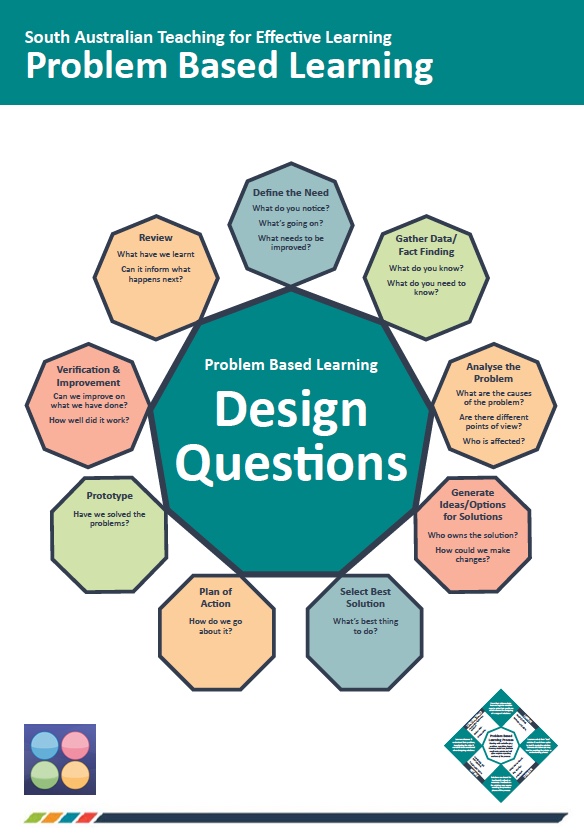
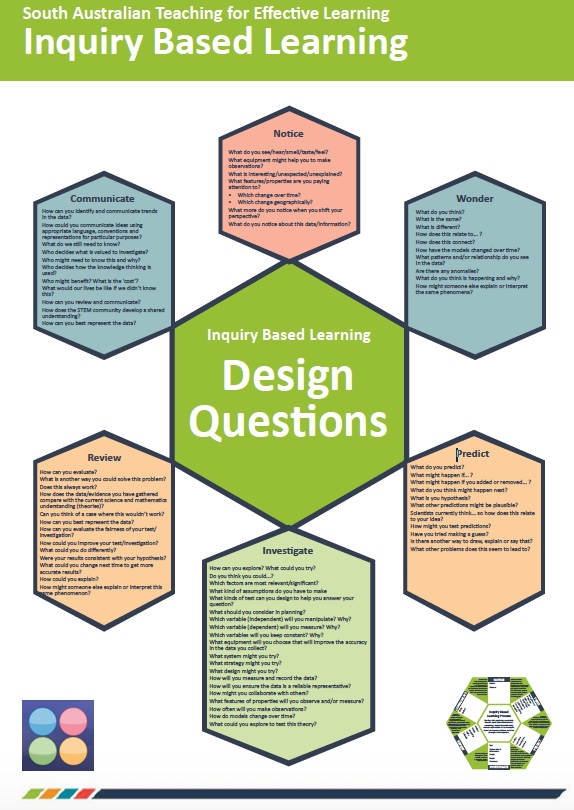
The problem based learning process (PBL) and inquiry based learning process (IBL) brings these frameworks to life by facilitating learners to construct their own understanding in real-world contexts. 

Both the problem based learning process and inquiry process shift learning from surface to deep learning of STEM knowledge, understandings, skills and thinking.

In problem based learning learners are challenged to define or find a problem to solve. The emphasis of the learning is on the process and thinking, and not the final product, solution or idea.

Inquiry based learning in STEM refers to the scientific and mathematical systematic process of inquiry. A phenomenon is noticed or wondered about and from these observations learners pose a question to investigate and design a fair test to determine their product, solution or idea, informing their explanation.

The intentional focus on “intellectual stretch for all” in STEM learning design illustrated in these processes develops learner resilience in the face of unfamiliar and non-routine problems and contexts. 
These processes foster metacognition and engagement in productive struggle that develops a deep understanding of STEM concepts and skills as well as learning expertise.


3 June 2018

Science as a Human Endeavour SACE assessment BIOSECURITY example


Science as a Human Endeavour SACE assessment EXAMPLE

South Australia is the only Australian mainland state that is free of fruit fly. The prevention, detection and eradication of fruit fly is managed by biosecurity. Biosecurity SA has constructed a $3.8 million Sterile Insect Technology (SIT) facility in Port Augusta to help combat the threat of fruit fly.   
                          

link to more information (http://pir.sa.gov.au/biosecurity/fruit_fly/what_we_do)

Senior Science BITL questions:
·       How might the development of biosecurity impact on South Australia socially, economically and culturally?
·       What ethical considerations might need to be considered if biosecurity is introduced for this scientific knowledge of fruit flies and the control of other species? 
·       How might biosecurity of fruit flies be beneficial for society? Could it be harmful for society?
·       Can you think of any unintended consequences for how this scientific knowledge might be used?
·       How might this scientific knowledge be used to evaluate projected economic, social and environmental impacts?
·       How might this scientific knowledge be used to design action for sustainability and provide opportunities for innovation? 
·       How might this scientific knowledge be used to inform the monitoring, assessment and evaluation of risk? 
·       How do scientists offer reliable and valid explanations?
·       How does scientific knowledge enable scientists to make reliable predictions?
·       How can scientists communicate the uncertainty of the data available while still being supporting the public with debate over an issue? How can scientists support the interpretation of the data to the public to reduce it being open to question?


Key concept of Science as a Human Endeavour used in this example:
Application and Limitation
·       Scientific knowledge, understanding, and inquiry can enable scientists to develop solutions, make discoveries, design action for sustainability, evaluate economic, social, and environmental impacts, offer valid explanations, and make reliable predictions.
·       The use of scientific knowledge may have beneficial or unexpected consequences; this requires monitoring, assessment, and evaluation of risk, and provides opportunities for innovation.
·       Science informs public debate and is in turn influenced by public debate; at times, there may be complex, unanticipated variables or insufficient data that may limit possible conclusions.


11 March 2018

The biggest predictor of success in STEM is spatial reasoning.

The biggest predictor of success in STEM is spatial reasoning.

Spatial thinking is fundamental to problem solving in a variety of contexts: in life spaces, physical spaces, and intellectual spaces.
Findings from the Project Talent research project revealed that students with high spatial reasoning were more likely to choose STEM careers than students with lower scores, even after accounting for the fact that they often had higher verbal and mathematical scores.
This study measured spatial reasoning skills of approximately 400,000 people for over 50 years from their high school years and into their adult life.
Wai, J., Lubinski, D. and Benbow, C.P., 2009. Spatial ability for STEM domains: Aligning over 50 years of cumulative psychological knowledge solidifies its importance. Journal of Educational Psychology, 101(4), p.817.
Spatial skills are not innate and can be improved with training.

Spatial reasoning skills:

Visualisation and imagery
Location, arrangement, orientation, and structure
Visual and graphical arrays
Maps and timelines
Sequencing


Translating (encoding) features and properties
• distinguishing figures from ground;
• pattern recognition - both outline shapes and internal configurations;
• evaluating size;
• discerning texture;
• colour evaluation
• determining other features / properties.
•
Representation of static features and properties
• determining orientation
• determining location,
• assessing distance,
• comparing size, colour, shape, texture, location, direction and other features/ properties
Representation of dynamic features and properties
• direction of movement,
• behaviour of motion,
• speed or acceleration, and
• intersection or collision.
Spatial transformations
• changing perspective such as changing your frame of reference,
• changing orientation such as mental rotation,
• transforming shapes,
• changing size,
• moving wholes,
• reconfiguring parts.
• zooming in or out,
• enacting, and
• panning.
Just a very few ideas
Learning spatial thinking in Early Years
Mathematics : explore butterfly symmetry using felt shapes and mirror images
Science : playing with egg parachutes
Technology : draw a map of hide and seek in the playground and make a model of it
Learning spatial thinking in Primary Years
Maths : make tangram letters using tangram shapes
Science : noticing and recording observations of insects – size and colour of wings, how the wings are folded
Technology : 3D printing software – mental rotation
Learning spatial thinking in Secondary Years
Maths : Tessellations: these help students to develop slides, flips, and rotations. Use an Isometric Drawing Tool
Science : rotate augmented molecules or use molecular kits to construct 3D models of molecules,
Technology : designing an interface for reading data in real time

10 December 2017

The Science of Kindness - an inquiry

THE SCIENCE OF KINDNESS

There are scientifically proven benefits of being kind
Kindness is teachable


You might like to try doing a kindness inquiry and see if the effects do decrease stress, anxiety, blood pressure, and increase energy levels, happiness….especially at the end of a busy year.
What are you going to measure?

Watch the video or read the file on the science of kindness to determine what you are going to measure. 
You might use a blood pressure monitor or a fitness app or your garmin / fitbit / applewatch to measure your blood pressure.

What might you do to find out?
The kindness calendar has some ideas that everyone can try. 


After a few days what do you notice?
What does it make you wonder?
Does being kind pay forward?


18 November 2017

Should we clone humanoid robots that are citizens? STEM & Ethical thinking

We made a decision not to clone humans so would we also decide not to clone human robots that are citizens?


                              STEM and Ethics

  • What do you notice?
  • Create a narrative around the future that you see? 
  • What is missing or not represented?
  • What are all the positives? 
  • What are all the negatives?
  • How will changes in technology impact our lives in the future and the lives of future generations?
  • How might you be part of the production of new innovations?
  • What role does society have in the future? 
  • What values will impact our decisions in how new innovations and technology are funded, created and used?
  • Just because we can, should we?
  • We made a decision not to clone humans so would we also decide not to clone human robots that are citizens?
Video Youtube

https://www.youtube.com/watch?v=NZ5wcoRFcGw

*Sophia was awarded an honorary citizenship as a PR exercise for a Tech conference in Saudi Arabia.

15 November 2017

Literacy Arts Science Multi-mode communication and meaning making (transdisciplinary)


Soil Dwellers : Who makes their home in the soil?
How alive is your soil?
How many different organisms call soil their home?
Have you seen any rabbits, bilby’s, hopping mice, bandicoots, wombats or foxes living in the soil? What do we call these homes that animals make in the soil? Do they all have the same name?
Do they all make their home in the same way? What features/ body parts do they have that helps them to make their homes?
What kinds of insects or invertebrates live in the soil? How far down do they live in the soil? What other questions do you have?
Are there organisms in the soil growing that we cannot see? How could we find out?
What else do you see living in the soil?
Make a picture using the different materials to show what it looks like when an organism makes a home in the soil.
Poem called: What Remains by Sheryl Shapiro
Burrowing
I enter the dark, sweet depths
surrounded
enveloped
by fragrant scents
of the generations
Burrowing transforming fragments
into essential elements
rooting new life
Burrowing
through the hard pan
the stones
jagged
and
round
Excavating
with nail and nose
Passage
to an underground nest.