23 September 2024

Australian Curriculum V9.0 Key Ideas Patterns,order and organisation


Australian Curriculum V9.0 Key Ideas Part 1

1. Patterns,order and organisation

What’s important is that the Key ideas and the understanding that sits beneath them are equally relevant to students who want to go on and work in science as it is for those who want to live with an appreciation of science. They are incredibly unifying and equitable.

What they are:

The key ideas distil down scientific knowledge into six guiding principles that we can use to explain a diversity of scientific phenomena.

The key ideas are designed to :

       provide lenses by which we can make sense of the world,

       support teachers and students to make connections across the 3 strands of science,

       support the coherence of science understanding within and across year levels throughout Reception to Year 10.

What they are not:

Whilst big ideas help to frame the ultimate goals of science education, it’s important to recognise that big ideas cannot be taught directly.

If we try to devise activities that teach big ideas directly, we end up with some superficial activity.

We don’t teach students directly about each key idea but provide opportunities for them to learn how there are key ideas underpinning the science concepts found within each strand ->sub strand -> content description

Key Idea: Patterns, order and organisation

       An important aspect of science is recognising patterns in the world around us and ordering and organising phenomena at different scales.

       As students progress from Foundation to Year 10, they build skills and understanding that will help them to observe and describe patterns at different scales and develop and use classifications to organise events and phenomena and make predictions.

       As students progress through the primary years, they become more proficient in identifying and describing the relationships that underpin patterns, including cause and effect.

       Students increasingly recognise that scale plays an important role in the observation of patterns; some patterns may only be evident at certain time and spatial scales.

What do patterns have to do with science?

·         Children naturally develop the skill of pattern recognition but perfecting that skill requires explicit teaching for students to understand how patterns connect mathematics and science.

·         Teachers need to provide opportunities for students to learn how to detect patterns, how to understand patterns, how to analyse patterns, how to use patterns and how to find new patterns.

Why teach science through the Key Idea Patterns?

       Patterns support the development of scientific explanations, theories, and models.

       To support students in understanding core concepts, patterns need to be visible and explicit.

       To engage students in scientists’ science, we need to engage students in using patterns as part of the scientific practices.

       Noting patterns as a starting point for asking scientific questions,

       Using statistics to determine the significance of mathematical patterns

       Mathematical representations are needed to recognise some patterns

       Empirical evidence is needed to identify patterns

       Basing arguments “on inductive generalisations of existing patterns”


30 March 2019

Creative Thinking in Nature of Science PART A (iv)

Part A (iv) Creative Thinking in the Nature of Science – How might you design an investigation?

Creative thinking is required to imagine multiple ways to investigate an hypothesis.

How might you explore? Scientists have to come up with many ideas on how to investigate their questions using different research techniques and knowledge/ technology available.
Scientists use creative thinking to imagine multiple ways to design an investigation and reflect on whether their design will measure what they intended to find.
In the best science investigations, its not the questions that are most creative, but rather how the experiment is measured and how the data is interpreted.
How might you design an investigation?
It is important in science education for students to learn the science inquiry skills and processes to develop a deeper conceptual science understanding. However, if students only have the opportunity to perform guided / recipe experiments then they are limited to explore and construct their own explanations for their investigable questions. A worthwhile objective for teaching science is to allow students to think and act like scientists, by designing their own investigations, using open ended inquiry, rather than to solely learn or replicate what other scientists have already done.
Seeing there is more than one scientific method provides meaning for how students see the investigation as a component in understanding a scientific problem.
Dudley Herschbach said, “People thought it would not be feasible. It was called the lunatic fringe of chemistry, which I just loved.” He ignored his critics, and set out to see what would happen if he crossed a beam of molecules such as chlorine with a beam of hydrogen atoms. He spent several years collecting his data, which in the end uncovered new insights into the ways colliding molecules behave. In 1986 Dudley Herschbach and Yuan Lee were awarded the Nobel Prize "for their contributions concerning the dynamics of chemical elementary processes."

Disney's Dumbo the flying elephant is magical to watch. Last night I took my son to see the 2019 movie.
Imagination - What if an elephant could fly? How could you design a model to show your scientific thinking?

Imagine you designed a model of Dumbo. In order to achieve take off what might the wing span of Dumbo’s ear have to be if a baby elephant weighs about 90 to 100 kilograms. What other questions would you need to consider?
For example: Which type of elephant would you base your model on because it would be the most aerodynamic? Which elephant shape is more streamlined? How might you explore this idea? What investigation could you try? Which is your best idea?
Which things (variables) will you keep constant? What factor (variable) will you measure?


I was wondering how they made the elephant bubbles when I was watching the movie. (Was it special effects?)
Is it possible to make animal shape bubbles? How might you explore this phenomena? How many different ideas have you come up with?
The official trailer for Dumbo https://youtu.be/7NiYVoqBt-8

18 March 2019

Creative Thinking in the Nature of Science PART A (iii)

Part A (iii) Creative Nature of Science – What do you think if…?
Continuing on from part (i) creative thinking is required to make observations, to notice (what do you notice?) and part (ii) creative thinking is required to interpret and make inferences from your observations (what do you wonder?)
Part (iii) creative thinking is required to make predictions and hypothesise. What do you think if?
Creative people in any field come up with new ways of looking at the world – they are constantly asking, "What if...?" 

"What if...?" is an important question in science. Hypothesising is an intrinsic and creative mental process where information, perceptions, and different ideas are being combined and recombined until a particular combination seems to make sense.
McComas (1998) stated “close inspection will reveal that scientists approach and solve problems with imagination and creativity, prior knowledge and perseverance.” (p. 58).
In order to stay open to possibilities, imagination is critical. The idea of using one’s imagination to approach a problem is important to teach in science. Eisner states, “ . . . this is what scientists and artists do; they perceive what is, but imagine what might be, and then use their knowledge, their technical skills, and their sensibilities to pursue what they have imagined” (Eisner, 2002, p. 199).
Students can find hypothesising difficult as there is not 'one' answer, and it is possible to come up with lots of suggestions that are not 'meaningful or useful'. Therefore we need to help students by enabling intuitive thinking that emerges from prior knowledge or experience, and not following a script.
Executive functions, such as, self-regulation of your emotions is needed in order to allow creative thinking to emerge. It is important to support students to learn how to cope with risk, confusion, disorder and delayed gratification when they are not progressing quickly.
But it doesn't stop there.
Cognitive flexibility and using creative convergence is required to consider a variety of different possibilities and then decide on the most plausible, useful or appropriate idea.
After a creative person asks "What if...?" they then go on to logically think through the consequences and narrowing down those new ideas to focus on one that can be elaborated.
Experts who study creativity have found that logical thinking is always a part of the creative process in any field, from art to science to business (Tardif & Sternberg, 1988)
Looking at the image:
“What if..?” question comes to your mind?
What if a black hole came close to the Solar System? What do you think would happen next?
Or
What might happen if the Earth fell into a black hole? What do you think would happen next?
What is your hypothesis?
What science ideas could help you explain this?
What do you already know or what have you observed that led to your prediction?
What reasons do you have for making that prediction?
What other predictions might be plausible?
What changes can we predict with accuracy?

One scientist currently thinks that if the black hole is massive enough, the Earth could glide right through it and we could live out a normal life? How does this relate to your idea?

What would happen if you put up a firewall to protect the Earth from a black hole?

Eisner, E. W. (2002). The arts and the creation of mind. New Haven & London: Yale University Press.
McComas, W. (1998). The principal elements of the nature of science: Dispelling the myths. In W. McComas (Ed.), The nature of science in science education: Rationales and strategies (pp. 53-72). Dordrecht: Kluwer Academic Publishers.


3 March 2019

Creative Thinking in the Nature of Science PART A (ii)

Part A (ii) Creative Thinking in the Nature of Science
In (i) creative thinking is required to make observations, to notice.
In part (ii) Creative thinking is required to interpret and make inferences from your observations. What do you think?
Beveridge “argues that the art of observation depends on developing the capacity for pattern-recognition, which in turn relies on a broad pool of networked knowledge that allows you to spot the piece that doesn’t fit”
(Beveridge, 1950. The art of scientific investigation.)
In carrying out effective scientific observation you deliberately notice for
each characteristic you know may be there, 
for any unusual feature or unexplained , 
and especially for any suggestive associations or relationships among the things you see, or between them and what you know.
In this image

What do you think? What do you wonder?
What do you know? What don’t you know?
What is the same? What is different?
What patterns / relationships can you recognise? Is there a hidden pattern?
Is there an outlier (s)? Was there something that you did not expect to see happening?
Did you need to see the bigger picture or wait for a prolonged period of time to see the pattern or connections?
What inferences are you making when you see this image?
What questions do you have? What burning question has it inspired in you to want to know?
Do we all make the same inferences? Ask some other people, what inferences did they make? Were their observations the same? If so, how did they make a different inference to you? If their observations were different, what did they notice differently to you? Why do you think they saw a different pattern? Can you justify why your inference is better? How do your observations support your justification? Do you need to change your thinking?
What new connections have you made?
Pattern recognition can lead to new discoveries, and innovative ideas and connections.
‘Creativity is just connecting things. When you ask creative people how they did something, they feel a little guilty because they didn’t really do it, they just saw something.’ (Steve Jobs 1996)

Creative Thinking in the Nature of Science PART A (i)

Part A i Creative Thinking Nature of Science
Stein, Smith, Henningsen, and Silver (2000) define Cognitive Demand as, “The kind and level of thinking required of students in order to successfully engage with and solve the task.
A problem that requires only memorisation is at the low end of cognitive demand. 
A problem that requires students to make connections between ideas in new ways requires a high level of cognitive engagement and therefore is at the high end of cognitive demand.
Research has shown that using high cognitive demand tasks in ways that support rigorous thinking will lead to increases in student learning. (Stein et al. 2009).
Creative Thinking is required to make Observations: What do you notice?
Observation is much more than merely using our senses;
it also involves a mental process which, may be partly conscious and partly unconscious.
Observation is one of the hardest skills to master mainly because we are so easily distracted and we look for the obvious.
Observation requires
• patience
• time
• creative space
• imagination
• making connections to prior knowledge or experience
• curiosity
You need to allow your mind to meander with no specific destination, imagine, look for patterns and relationships – those which are known and those which are unexpected or seem to be unusual and create uncertainty.
(2017 article in “Current Biology” UC Santa Barbara Study Shows Our Brains Wired To See The Big Picture, But We May Miss The Obvious)
Image from : 
https://www.theatlantic.com/…/this-article-wont-cha…/519093/
In this image – what do you notice?
What patterns can you see? What relationships can you see? What have you seen before?
What are the unusual things you notice?
Are you in a quiet place? Have a deeper look, focus – now what else do you see that you didn’t see before?
Is this unexpected?
Are you certain or uncertain?
What do imagine?

23 September 2018

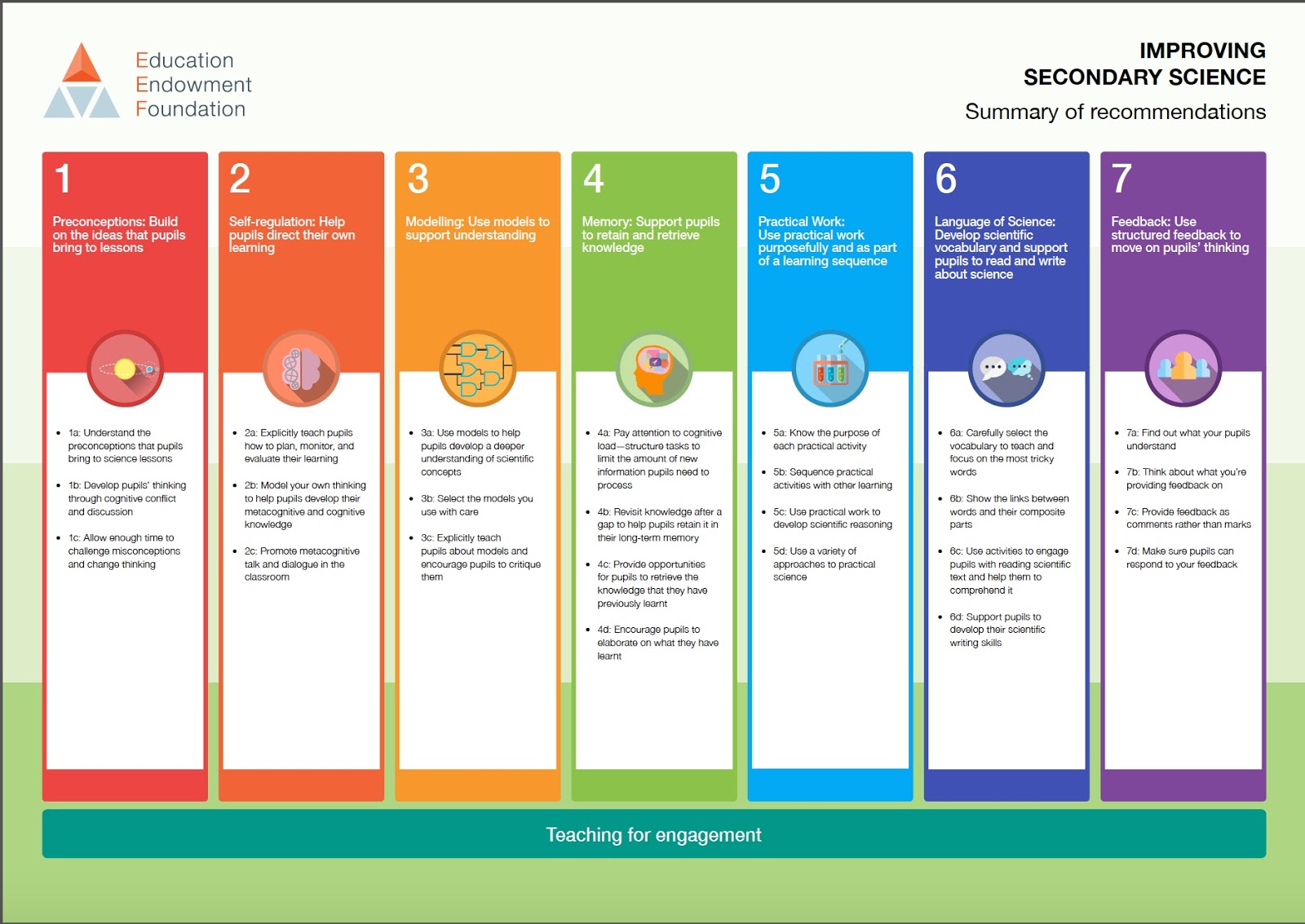
EEF Evidence How to improve Secondary Science

The Education Endownment Foundation EEF Improving Secondary Science guidance report offers seven practical evidence-based recommendations that are relevant to all students, but especially to those struggling with science. 

Literacy in science - make connections with Literacy guides

This image is summary poster but full report in on link.

Download now: https://eef.li/science-ks3-ks4 .

15 August 2018

SCIENCE WEEK - Science as a Human Endeavour ‘intellectual humility’

SCIENCE WEEK - Science as a Human Endeavour
On Friday August 10th many of South Australia’s scientists attended an awards dinner for excellence in science, by Department for Industry and Skills.
Many of the scientists were very humble in accepting the awards. Through their videos too you could see them show ‘intellectual humility’.
Research has found that people who prove to be intellectually humble are better at evaluating the quality of evidence. They can distinguish good arguments from weak ones much better, and criticise people less if they changed their mind on issue. Intellectually humble people were more likely to think that it was actually good when people change what they thought based on new evidence. (University of Edinburgh School of Philosophy MOOC 2018)
The scientists provide inspiration, open-mindness, integrity and intellectual humility in the short videos: View them on this link
http://industryandskills.sa.gov.au/…/sa-scienc…/2018-winners
YOUTUBE.COM
2018 SA Science Excellence Awards. Dr Justin Chalker, Senior Lecturer, School of Chemical and…

28 July 2018

I WONDER - fake meat and slaughter free

I WONDER - how would a meat eater compared to a vegetarian or vegan might respond to these Science BITL questions

Image from Link to article : http://www.abc.net.au/news/rural/2018-05-06/vegan-alternative-plant-based-meat-grown-in-lab/9726436
Questions
• How might the advances from this scientific understanding influence 
other areas of science, technology and engineering? 
• Do you think this scientific knowledge of culturing meat from stem cells should be accepted by society? Why?
• How might someone else explain or interpret what cultured meat is?
• Just because we can do this science should we?
• What ethical considerations might we need to consider with this scientific knowledge?
• Is the ethics for this science investigation the same or different in other countries compared to Australia?
• Scientists' values and beliefs are influenced by the larger culture in which they live. How might such personal views influence how they investigate finding new ways to produce meat?
• Was the scientific research focused on an issue with the potential to help meet societal needs or for economic reasons? How might these influence the scientific knowledge being accepted?
• Who decides what is valued to investigate?


SACE Science as a Human Endeavour
Influence 

• Advances in scientific understanding in one field can influence and be influenced by other areas of science, technology, engineering, and mathematics.
• The acceptance and use of scientific knowledge can be influenced by social, economic, cultural, and ethical considerations. 

http://www.abc.net.au/news/rural/2018-05-06/vegan-alternative-plant-based-meat-grown-in-lab/9726436

9 July 2018

STEM learning animation


What is STEM for?


STEM learning linked to Early Years Framework and Australian Curriculum


STEM animation produced by
Learning Improvement Division
South Australian Department for Education

Leading Learning Resource www.acleadersresource.sa.edu.au

19 June 2018

SACE SHE task: Just because we can transplant a human head, should we?

SACE Science as a human endeavour folio task – BITL questions

Just because we can transplant a human head, should we?

Investigating this question through the SHE key concept:

Influence 
Advances in scientific understanding in one field can influence and be influenced by other areas of science, technology, engineering, and mathematics. 
• The acceptance and use of scientific knowledge can be influenced by social, economic, cultural, and ethical considerations. 

• How might the advances from scientific understanding in neuroscience influence other areas of science, technology and engineering?

• Just because we can do this science should we?
• What ethical considerations might need to be considered with this scientific investigation? 

• Is the ethics/ ethical laws for this science investigation the same or different in other countries? How might the hypothesis change as a result of the ethical issues if the investigation was carried out in Australia?

• Scientists' values and beliefs are influenced by the larger culture in which they live. How might such personal views influence the questions they choose to pursue and how they investigate those questions?

• Is this scientific research focused on an issue with the potential to help meet societal needs or for economic reasons? How might these influence the scientific knowledge being accepted?

• Who decides what is valued to investigate?

https://au.news.yahoo.com/head-head-mad-scientist-behind-worlds-first-human-head-transplant-133408179.html

http://www.iflscience.com/health-and-medicine/human-head-transplant/

https://www.cnbc.com/2018/05/15/two-surgeons-in-china-developing-a-method-to-transplant-a-human-head.html

 #scienceasahumanendeavour #BITL #australiancurriculum  #science #ethics

5 June 2018

STEM Learning Problem and Inquiry based learning pedagogies


 STEM Learning

Problem based and Inquiry based Learning

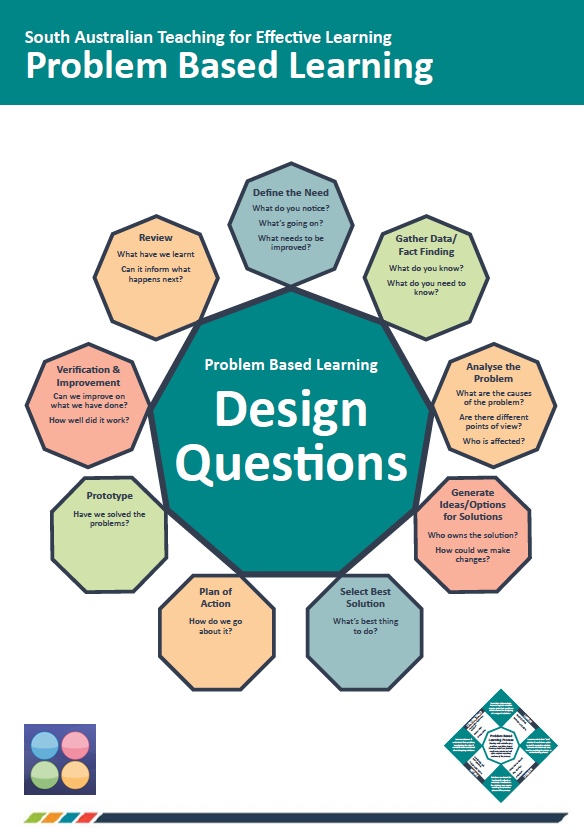
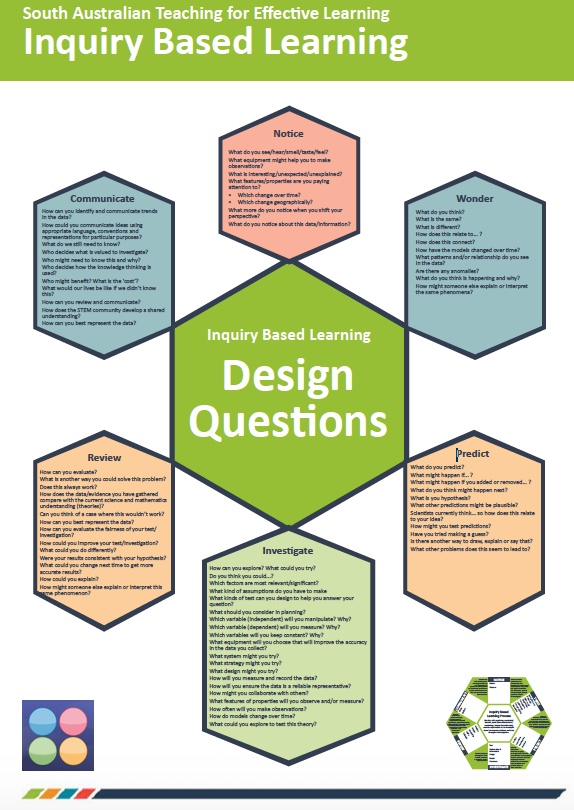
Challenge based learning, project based learning, problem based learning and inquiry based learning are some of the different processes that are described within the vast body of literature on teaching STEM. Each process provides a different way for learners to experience, explore and construct their understanding of STEM and the disciplines it embodies. 

The problem based learning process (PBL) and inquiry based learning process (IBL) brings these frameworks to life by facilitating learners to construct their own understanding in real-world contexts

Both the problem based learning process and inquiry process shift learning from surface to deep learning of STEM knowledge, understandings, skills and thinking.

In problem based learning learners are challenged to define or find a problem to solve. The emphasis of the learning is on the process and thinking, and not the final product, solution or idea.

Inquiry based learning in STEM refers to the scientific and mathematical systematic process of inquiry. A phenomenon is noticed or wondered about and from these observations learners pose a question to investigate and design a fair test to determine their product, solution or idea, informing their explanation.

The intentional focus on “intellectual stretch for all” in STEM learning design illustrated in these processes develops learner resilience in the face of unfamiliar and non-routine problems and contexts. 
These processes foster metacognition and engagement in productive struggle that develops a deep understanding of STEM concepts and skills as well as learning expertise.


3 June 2018

Science as a Human Endeavour SACE assessment BIOSECURITY example


Science as a Human Endeavour SACE assessment EXAMPLE

South Australia is the only Australian mainland state that is free of fruit fly. The prevention, detection and eradication of fruit fly is managed by biosecurity. Biosecurity SA has constructed a $3.8 million Sterile Insect Technology (SIT) facility in Port Augusta to help combat the threat of fruit fly.   
                          

link to more information (http://pir.sa.gov.au/biosecurity/fruit_fly/what_we_do)

Senior Science BITL questions:
·       How might the development of biosecurity impact on South Australia socially, economically and culturally?
·       What ethical considerations might need to be considered if biosecurity is introduced for this scientific knowledge of fruit flies and the control of other species? 
·       How might biosecurity of fruit flies be beneficial for society? Could it be harmful for society?
·       Can you think of any unintended consequences for how this scientific knowledge might be used?
·       How might this scientific knowledge be used to evaluate projected economic, social and environmental impacts?
·       How might this scientific knowledge be used to design action for sustainability and provide opportunities for innovation? 
·       How might this scientific knowledge be used to inform the monitoring, assessment and evaluation of risk? 
·       How do scientists offer reliable and valid explanations?
·       How does scientific knowledge enable scientists to make reliable predictions?
·       How can scientists communicate the uncertainty of the data available while still being supporting the public with debate over an issue? How can scientists support the interpretation of the data to the public to reduce it being open to question?


Key concept of Science as a Human Endeavour used in this example:
Application and Limitation
·       Scientific knowledge, understanding, and inquiry can enable scientists to develop solutions, make discoveries, design action for sustainability, evaluate economic, social, and environmental impacts, offer valid explanations, and make reliable predictions.
·       The use of scientific knowledge may have beneficial or unexpected consequences; this requires monitoring, assessment, and evaluation of risk, and provides opportunities for innovation.
·       Science informs public debate and is in turn influenced by public debate; at times, there may be complex, unanticipated variables or insufficient data that may limit possible conclusions.